

Few television programmes have been so closely associated with their presenters as Top Gear and The Grand Tour.
When you think about these hit TV shows, you instantly think of Jeremy Clarkson, Richard Hammond and James May. Their distinct personalities, unrivalled chemistry and fantastic ability to entertain transformed what was once dry automotive journalism into a global phenomenon.
So when Amazon announced the return of The Grand Tour with a completely new presenting line-up, scepticism was always inevitable.

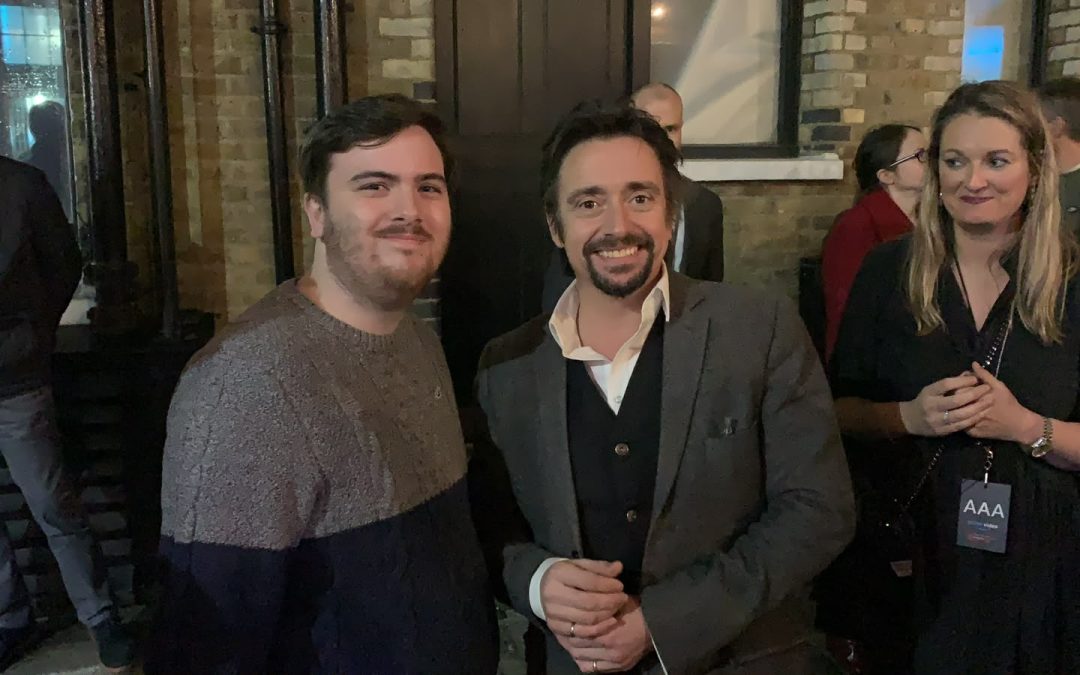
Ashley Robertson’s at the Grand Tour Season 3 launch with Jeremy Clarkson, Richard Hammond and James May
Could the combination of automotive YouTubers James Englesman and Thomas Holland, alongside social media personality and engineering enthusiast Francis Bourgeois, really take over one of motoring television’s most recognisable brands?
With the new series now live on Amazon Prime, there are some promising early signs.
For anyone working in PR and communications, the more interesting story isn’t whether the new Grand Tour is any good. It’s how Amazon has approached one of the hardest challenges in communications: how do we get customers and stakeholders to embrace a change when they’re apprehensive and already comfortable with or attached to what they have?
For financial services, this will be a familiar challenge. The industry is constantly changing – from technology and customer journeys to propositions, regulation and business models. The fact of the matter is that just because something is new, it doesn’t automatically mean it is desirable to the people who have to use it. Whether it’s lenders, advisers or tech providers, communicating change can be a considerable challenge.
So what can we learn from Amazon and The Grand Tour?
Don’t erase the past
One of the biggest mistakes an organisation can make when changing direction is acting as though the previous version of the business, brand or proposition never existed. This was basically the BBC’s strategy with Top Gear, thinking that by simply replacing the presenters and moving on, everything would be fine. It wasn’t.
“Let’s re-watch Chris Evans-era Top Gear,” said no one ever.
The Grand Tour took the completely opposite approach with the opening episode acknowledging the changing of the guard, with Jeremy Clarkson giving his blessing. Both Hammond and May also make appearances later in the series, with all three publicly showing support for the new line-up and encouraging them to make the show their own.
This is a highly effective comms tool in all walks of life. Whether it’s a new CEO, a rebrand, an acquisition or a new proposition or tech system, customers and stakeholders may have a strong attachment to what existed before. Acknowledging that isn’t a sign of weakness. It can be one of the most effective ways to build confidence in what is to come next.
Communicate with your audience
One of the best comms moves made by the team was far less glamorous than a posh press junket or a high-budget sizzle reel. It was a classic Reddit “Ask Me Anything”.
Executive Producer, Andy Wilman – a key figure behind the original trio’s success – took to social platform Reddit, inviting fans to ask him directly about the new series. As expected, the fans didn’t hold back.
They wanted to know how the new presenters had be chosen, how involved the original presenters had been, how much freedom this new line-up would get and how committed Amazon was to the project.
Wilman answered them.
He didn’t shy away from the uncertainty surrounding the new series – he confronted it head on. In the process, he used the equity he has built up with the audience to acknowledge the relationship between the programme and its viewers, the team’s commitment to delivering something fans will like and the role they now needed fans to play in supporting its new iteration.
It’s a real simple comms lesson: if you want people to buy into change, don’t just communicate at them. Communicate with them.
For businesses, that might not be a Reddit AMA – it could be a webinar or podcast, a community forum, a town hall, a Q&A with the CEO or customer-facing team members. It is providing stakeholders with the opportunity to ask important – and sometimes difficult – questions directly to the people responsible for the change.
When audiences are uncertain, polished corporate messaging and communications can only take you so far.
Don’t try to win everyone over
There’s another lesson that is easy to overlook. Amazon didn’t need to convince everyone that new series would be better than anything that has come before.
That would have been an impossible claim.
Instead, it need to give sceptical viewers enough reasons to watch. Then the programme had to do the rest.
There is often an understandable desire to get everyone on board with change right away, but that can lead to over-communication or even over-claiming. In reality, people need time to adjust and form their own opinion.
The same is true for a broker that needs to really test out a new platform, a customer that needs reassurance more than once or a new proposition that may need to prove itself over time.
Importantly, communicating change doesn’t finish when the change is launched. If anything, that next phase is just as critical. The new Grand Tour demonstrates why.
This new series has not made everyone forget the original – nor should it. Some viewers remain unconvinced, while others have praised this new version. Amazon doesn’t need universal acclaim from day one, it just needs to create enough understanding and curiosity for people to give the new version a chance.
That’s a much more realistic objective for businesses too.
Embracing what comes next
Introducing and communicating change is one of the hardest challenges a business will face – whether it’s Amazon or a mortgage lender or tech firm.
While it may just be #amazonshitcarshow (see what they did there?), there’s a cool case study for firms to consider.
Amazon acknowledged the past, listened to its audience and retained key elements of what made The Grand Tour so successful. At the same time, it has put credible, authentic people at centre of this new proposition – fully supported by the old guard – and given those people the space to develop. Crucially, it has accepted that some of the audience will need time to come around and that communicating that change remains a priority, even though the new show is now live.
In every scenario, the aim is not necessarily to make customers and stakeholders love change. Instead, it is to help them understand why it’s happening, listen to what matters to them, address any concerns they may have and preserve what they value. Above all, it’s demonstrating why the new world is worth moving towards – moving beyond explaining change to giving people a reason to embrace it.
Need to communicate change?
At bClear Communications, we are specialists in PR and communications in the financial services sector. We work with a broad range of organisations to help them turn complex messaging and into communications that connect.
If you’d like to find out more, get in touch here.
Written by: Ashley Robertson
Read our next blog on: EU has changed the rules on AI: here’s how it affects you